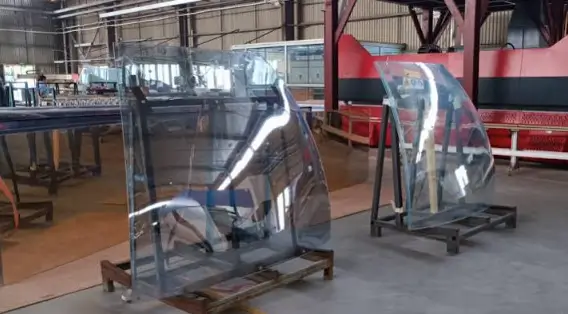
Curved glass has become an increasingly useful material in contemporary architecture, transportation, furniture, interiors, and specialized design. Its ability to create smooth shapes and distinctive visual effects allows designers to move beyond the limitations of traditional flat panels.
However, manufacturing curved glass requires careful control. Heating, shaping, transportation, cooling, and inspection must work together to produce consistent results. The production equipment must therefore be capable of handling the physical and thermal requirements associated with curved products.
Why Curved Glass Requires Specialized Processing
Flat glass and curved glass do not behave identically during thermal processing.
When glass is heated, its physical properties change, allowing it to be formed under controlled conditions. Producing a specific curve requires accurate control of temperature and movement throughout the process.
The complexity increases when manufacturers work with different dimensions or thicknesses. Equipment must provide sufficient flexibility while maintaining repeatable production conditions.
Applications of Curved Glass
Curved glass can be found in numerous industries.
In architecture, it may be incorporated into façades, entrances, railings, partitions, and distinctive building features. In interiors, curved panels can contribute to furniture, displays, counters, and decorative structures.
Transportation applications may also use shaped glass where particular design and visibility requirements exist.
These different applications mean that manufacturers often need equipment capable of supporting multiple product specifications.
The Heating Stage
Heating is a fundamental part of the process.
Glass must reach an appropriate temperature before it can undergo the required forming or tempering treatment. However, heating needs to be carefully controlled to prevent unnecessary differences between various areas of the sheet.
A sophisticated furnace can divide the heating process into controlled zones. Operators can then manage production settings according to the glass being processed.
Maintaining Shape Accuracy
One of the main challenges in curved glass production is achieving the intended shape consistently.
Small differences in temperature, timing, or mechanical movement can influence the final product. Consistent equipment operation is therefore important for maintaining dimensional accuracy across production batches.
Quality checks should be carried out throughout the production process rather than relying entirely on final inspection.
The Importance of Roller Design
The transport mechanism plays a major role in curved glass processing.
Rollers need to support smooth movement while accommodating the changing shape of the glass. Their configuration and condition can affect production stability.
Regular inspection is therefore necessary. Worn or improperly aligned components may create operational problems and should be addressed according to maintenance procedures.
Cooling and Tempering
After heating and forming, glass may undergo controlled cooling to achieve the desired properties.
Cooling must be managed carefully because rapid changes in temperature can create stresses within the material. The appropriate cooling conditions depend on the glass type, dimensions, thickness, and intended application.
An integrated production system can help manufacturers coordinate heating, shaping, and cooling stages more effectively.
See also: Technical Drying Services: Applications, Methods and Industrial Uses
Quality Inspection
Inspection is essential for maintaining consistent production.
Manufacturers may examine dimensions, surface appearance, shape, optical characteristics, and other product requirements depending on the application.
Inspection procedures should be established according to customer specifications and applicable industry requirements.
Recording production information can also help identify patterns if quality issues occur.
Handling Different Glass Specifications
A flexible production system can be useful when a manufacturer handles multiple glass specifications.
Different thicknesses may require different heating parameters. Similarly, large panels can have different processing requirements from smaller components.
Operators should therefore maintain clear production procedures and parameter records to reduce setup errors.
Maintenance for Reliable Production
Curved glass equipment contains numerous mechanical, thermal, and electrical components.
Routine maintenance can help support reliable operation. Cleaning, inspection, calibration, lubrication where applicable, and replacement of worn components should follow manufacturer recommendations.
Preventive maintenance is particularly useful because unexpected equipment failure can interrupt production schedules and affect customer deliveries.
Selecting Appropriate Equipment
Equipment selection should begin with a clear understanding of the company’s products.
A manufacturer should consider:
- Maximum and minimum glass dimensions
- Thickness range
- Desired curved shapes
- Production volume
- Automation requirements
- Available factory space
- Energy consumption
- Maintenance requirements
- Technical support
This information can help narrow the available options and create a more realistic investment plan.
Manufacturers researching curved thermal processing solutions can review the EASTTEC Top Convection Curved Glass Tempering Machine with Hard Roller as part of their technology comparison process.
Frequently Asked Questions
1. Why is curved glass more challenging to manufacture than flat glass?
Curved glass requires controlled shaping in addition to thermal processing. Maintaining the intended geometry throughout heating and cooling requires suitable equipment and accurate production parameters.
2. What industries use curved glass?
Curved glass is used in architecture, interiors, transportation, furniture, displays, and various specialized applications.
3. How can manufacturers maintain consistent curved glass quality?
Consistent material preparation, controlled heating, stable mechanical movement, appropriate cooling, regular maintenance, and systematic inspection can all support production consistency.
Conclusion
Curved glass offers designers valuable possibilities, but producing it consistently requires specialized technology and careful process management. Temperature control, mechanical movement, shape accuracy, cooling, and inspection all contribute to the final result.
Manufacturers should evaluate equipment according to their actual product range and production goals. By combining suitable machinery with trained operators and structured quality control, businesses can build a reliable process capable of supporting modern curved glass applications.
